Painting, drawing, photography, woodwork, vintage apparatus, and hand-built objects keep the work grounded in physical making.
About
Between tactile art and technological systems.
James Malzahn is a Canadian interdisciplinary artist and technologist based in Kitchener-Waterloo. He holds an MFA from the University of Waterloo and a BFA Honours from the University of Manitoba. His work investigates surveillance, propaganda, artificial intelligence, synthetic archives, and human-machine collaboration through immersive installations, moving image, photography, painting, drawing, sound, and custom electronic systems.
Artist statement
Technology is an environment, collaborator, material, and instrument of power.
I am an interdisciplinary artist whose practice moves between traditional studio methods and computational systems. I work with installation, painting, drawing, photography, moving image, sound, custom electronics, browser-based media, and artificial intelligence.
A recurring concern is the way technology reorganizes perception and power. My surveillance-based projects examine how networked cameras, data collection, and machine vision convert ordinary people into images, records, and actionable information. Other works look at propaganda, synthetic archives, and the visual authority of institutions, asking why certain images and interfaces are trusted.
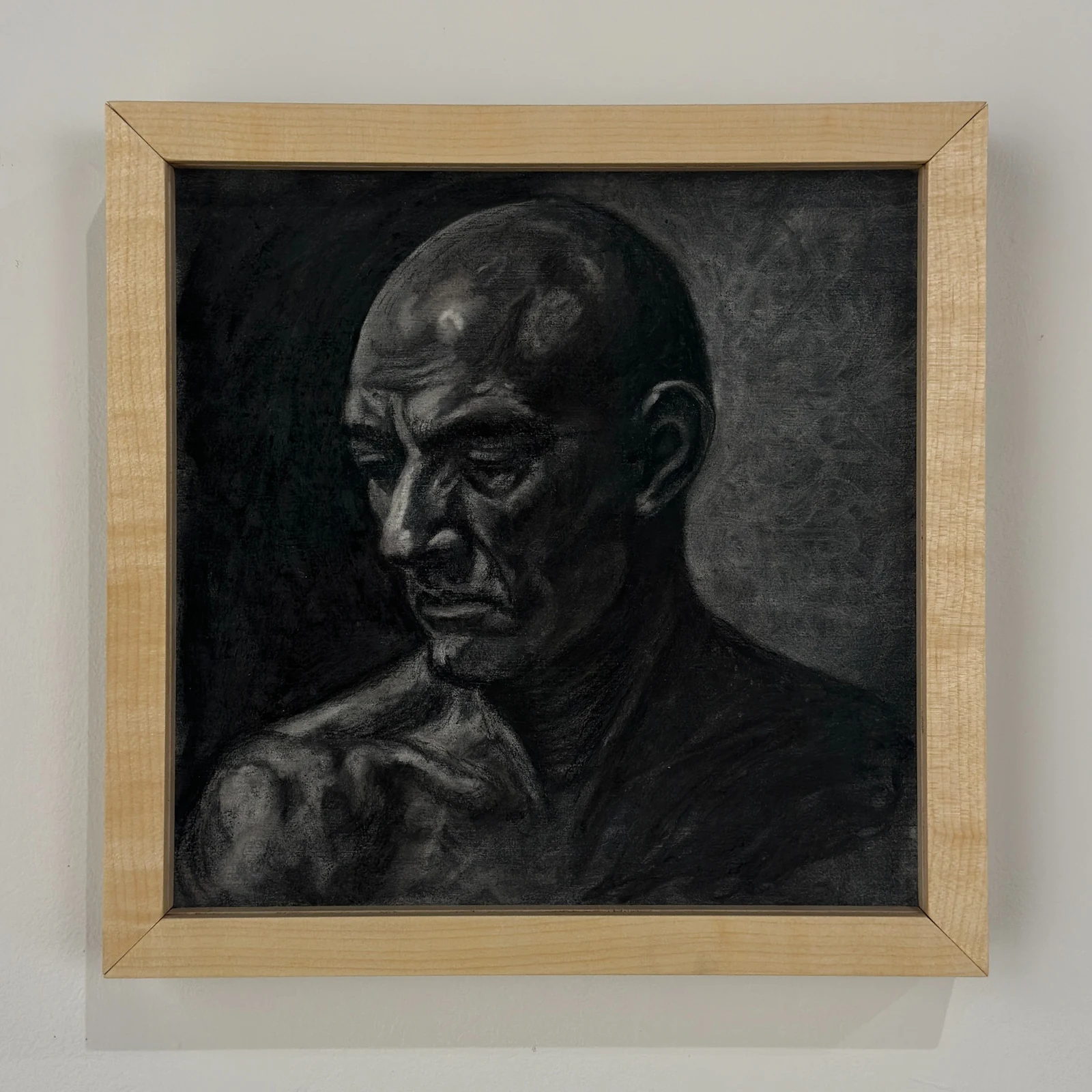
Artificial intelligence has two distinct roles in the practice. It can be a mechanism of persuasion, classification, and synthetic evidence, but it can also function as a collaborator. In projects developed with Lucid, generated images and conversations move back into charcoal, painting, sound, and physical fabrication, creating a slower exchange between statistical systems and embodied labour.
The work often places viewers inside an apparatus rather than explaining it from a distance. A camera records, a screen responds, a hidden text becomes visible, or a familiar object quietly changes the viewer’s position. The aim is not to reduce technology to either optimism or fear, but to hold its creative, connective, coercive, and dangerous capacities in the same field.
Working modes
Material, system, encounter.
Cameras, browsers, AI models, sound, sensors, and archives become structures that organize attention and behaviour.
Viewers are placed inside situations where trust, evidence, privacy, and agency become unstable rather than simply explained.
Approach
Build the conditions. Let the viewer discover the argument.
The work rarely asks an audience to accept a conclusion in advance.
Instead, it constructs a system with an ethical pressure: a camera quietly records, a synthetic archive gains authority through repetition, a hidden transcript becomes visible, or a reassuring interface becomes an instrument of classification.