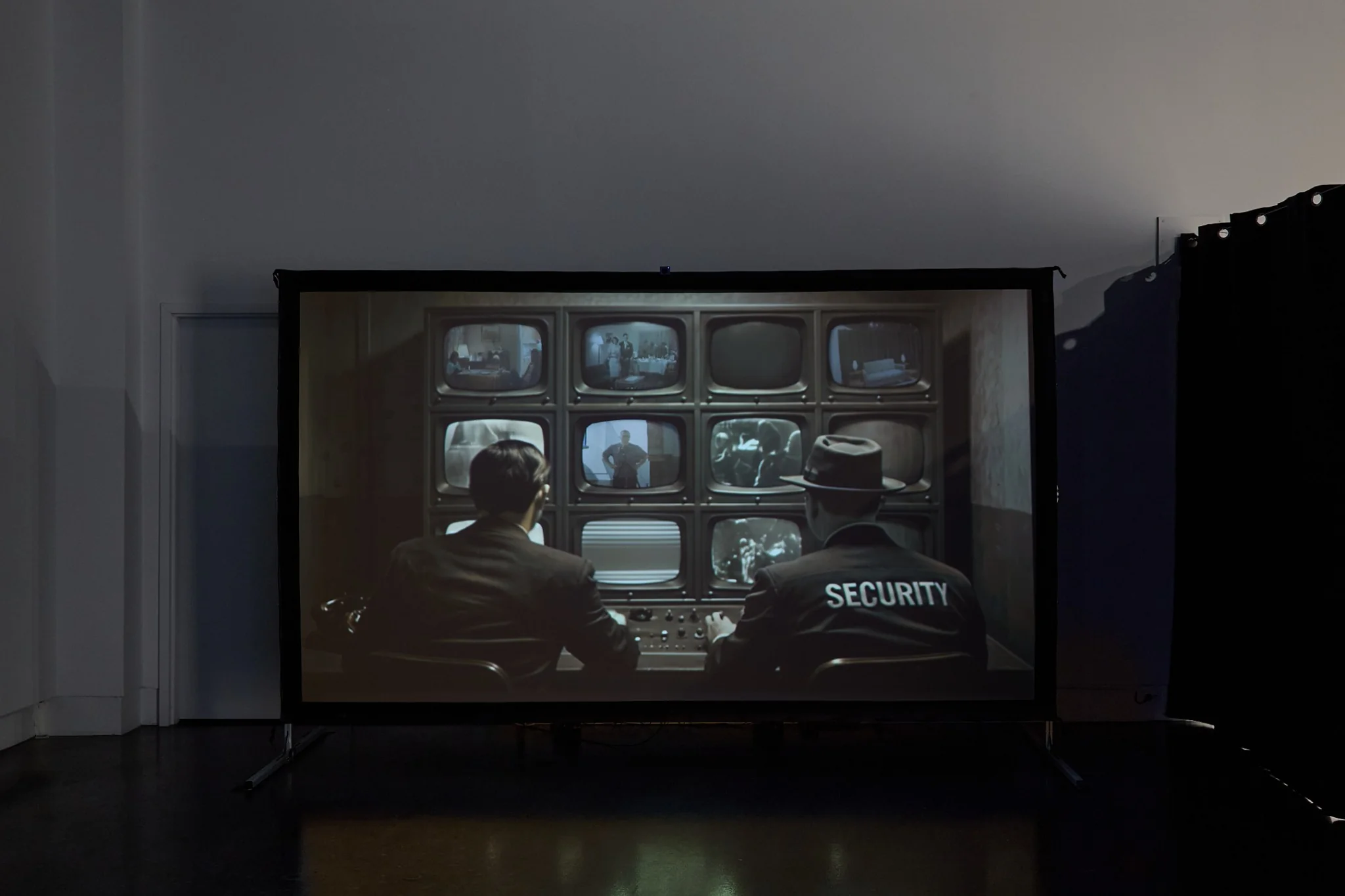
The installation appears to be a recovered Cold War surveillance film projected through a modified mid-century film apparatus. Two AI-generated agents sit before a wall of monitors. As visitors watch, live and previously recorded gallery footage is composited into the scene, collapsing the distinction between historical image, synthetic image, and present-tense observation.
A recovered film that is still operating
The projection is scaled so the agents appear approximately life-size. A period screen, vintage wooden table, labeled film canisters, and a modified 1950s projector shell give the moving image the physical credibility of an archival object.
That credibility is deliberately unstable. The apparent film is generated and assembled through contemporary systems, including AI video, a local browser, live cameras, prerecorded surveillance clips, and layers of simulated grain, scratches, flicker, and gate weave.
Browser-based compositing
Instead of pre-rendering one finished video, a local browser plays the AI-generated base scene while independently positioning multiple video streams over the monitor surfaces inside it. One screen receives clips recorded by the Victory Box. Another receives a live gallery feed. Additional monitors show synthetic domestic footage.
Because the streams remain independent, the historical-looking image can respond to the exhibition in real time. The screen no longer represents surveillance; it performs it.
From spectator to subject
The work is structured around delayed recognition. Visitors first read the image as an archival reconstruction. When their own body appears inside the monitoring system, the safe distance of spectatorship collapses. The past seems to observe the present, while the present is recast as evidence inside a past that never existed.
This perceptual reversal links the installation to machine vision and operational images: images designed not only to be seen, but to classify, direct, and act upon the world.